


Team engagement starts with your leadership.
In the previous article, we talked about building a season and culture of gratitude, and how recognition and appreciation become part of how your store runs every day. If you have started to build that, you have already laid the foundation for something bigger: team engagement.
Engagement is one of the most overused words in our business, and because of that, it has lost some of its meaning. For a lot of leaders, it brings one thing to mind: a score. It is the survey the HR team sends out once a year, the number that shows up on a report, the thing you do not want to come in low on so your manager is not asking questions. If that is what engagement means to you, it is time to rethink it.
Engagement is never about a score. Engagement is what you actually see your people doing.
Picture What Engaged Really Looks Like
Here is a simple exercise. Sit down somewhere away from the sales floor and all the noise, and ask yourself one question: what would an engaged team actually look like to me? Not on a report. In your store(s), on a normal day.
You will likely find it ends up being many little things, and not one big thing that matters. The engaged person is the one who does the right thing when no one is looking. And you can see it, because they do not always know you are watching. You catch them going an extra step for a customer, asking a couple of extra questions to really solve the problem, picking something up off the floor or straightening a shelf that no one asked them to, or seeing what is coming next and just getting it done.
That probably doesn’t show up on a survey. Many of your best employees won’t even realize that those small things are standout things. They just do it because they care. But when you see it, you know. That is engagement. And, wow, that is far more important than a score on a once a year survey.
Where Gratitude Comes Back In
Those quiet moments are exactly what you want to recognize. Go back to what we talked about last time. When you catch someone doing the right thing, especially when they did not realize you saw it, call it out. Thank them for the extra step they may not have even made on purpose, because for them it was just doing the right thing.
That does two things. It tells that person you see them, and it lets the whole team hear what good looks like. You can take it a step further, too. Recognize them in front of the group, and then catch them one-on-one later to say you really appreciate how they show up each day. Now you have reinforced it both ways, and you have given that person every reason to keep bringing their best.
This is the engine of the whole thing - it is almost like a gratitude flywheel. Recognition and gratitude feed engagement. Engagement shows up as better performance, a better experience for your customers, and a better experience for your team. That, in turn, is what keeps good people from leaving for another job. And all of it loops back to strengthen the culture you are fostering, which makes the next round of recognition mean even more.
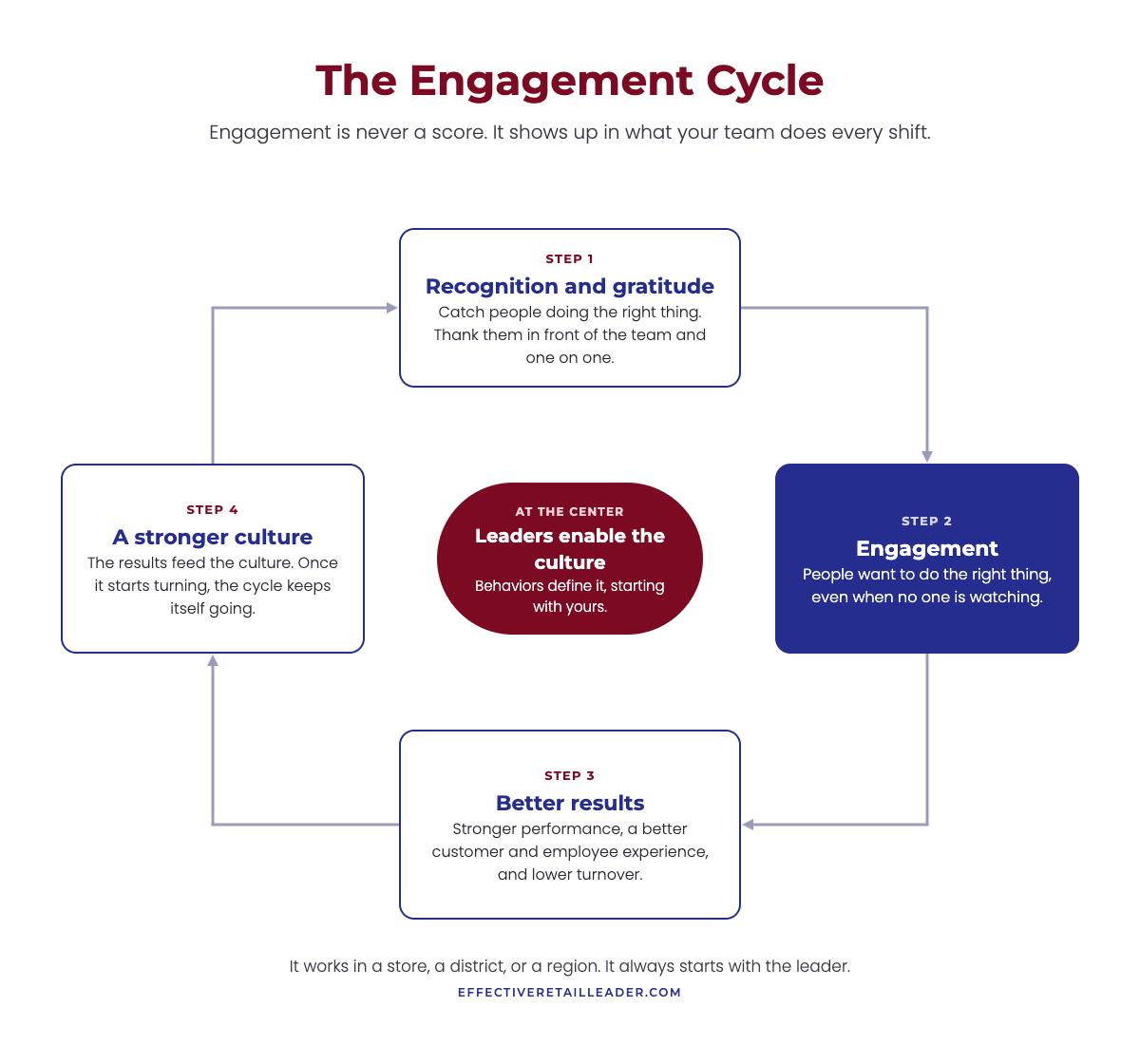
It Starts and Ends With the Leader
I’ve said this before and I will keep saying it it. A leader does not create culture. A leader enables it. You can say anything you want about your values. You can put them on a poster in the break room. But your culture is not what you say. It is what your people actually do, every shift, especially when you are not in the building. That is why engagement cannot be directed or demanded. It comes from the culture underneath it, and those positive energy cultures only become a reality when the behaviors are real.
A leader does not create culture. A leader enables it.
This works at every level. A store manager builds it on the floor, a district manager builds it across a market, a regional leader builds it across a region. The scale changes, but the starting point never does. It starts with the leader setting the example and creating the conditions for it to happen.
So this season, as you recognize your team and build that culture of gratitude, know that you are doing more than making people feel good. You are building engaged team members who want to do the right thing, for their customers, for each other, and for the business. That is what real engagement is. It is never a score. It is a reflection of your leadership.
How do you enable and foster culture in with your team?
Get leadership tips and new articles you can use directly in your inbox. Join the thousands of other leaders continuing your leadership development journey with Effective Retail Leader.com.
DISCLAIMER: As an Amazon Associate, this site earns commission from qualifying purchases. Other links to third-party products and services may also be affiliate links.