

Morning Routines Have Been Around for More Than 2,000 Years. Does Yours Set You Up For Success?

Protect the first hours of your day to establish intentional priorities.
Do you hate mornings? Many people dread the sound of that alarm going off. And there is some science behind that feeling. Before your feet hit the floor, your body is already working against you. Cortisol, your main stress hormone, spikes somewhere between 38 and 75 percent in the first thirty to forty-five minutes 1 after you wake up. It isn’t anxiety (well, maybe not entirely) and it’s not a bad night of sleep catching up with you. It is just biology, doing what it does every morning of your life.
But then most of us make it worse. Recent research indicates that 85 percent of people check their phone within ten minutes of waking up 2. So before your body has even settled from that cortisol spike, you are already looking at an inbox, a calendar, and a list of things other people need from you.
You have handed your morning over before you have decided anything for yourself.
Before your eyes are even fully open, you can find yourself immersed in a problem, question, or comment that pushes the stress meter up. It doesn’t matter whether it is someone calling or texting out sick, an email with a snarky comment, or a boss asking for something you have answered a dozen times before. Your blood pressure rises, and you feel compelled to act.
I do not think this is a small problem. I think it is the actual problem behind half the insane sounding mornings I hear leaders talk about. It is not that people do not have a routine. It is that they let their phone decide what the day is about before they have had a chance to decide for themselves, and many don’t feel like they have a choice.
(What was your immediate reaction when you read that paragraph? I know for me, several years ago, it would have been, “but you don’t understand, my role/boss/job requires it. I have to check messages and email, otherwise I feel behind.”)
I get it, I do. But I would challenge whether it is truly required or an assumption. And two, does it have to be the first thing in the morning? Could all of that wait 30 minutes, 45 minutes, an hour? Would the outcome or situation change? What would happen if you woke up later, so you didn’t see it for another hour? I point this out, because I know it is hard to break away from this, but keep an open mind as we talk through what it could be like.
My first hour: protect it
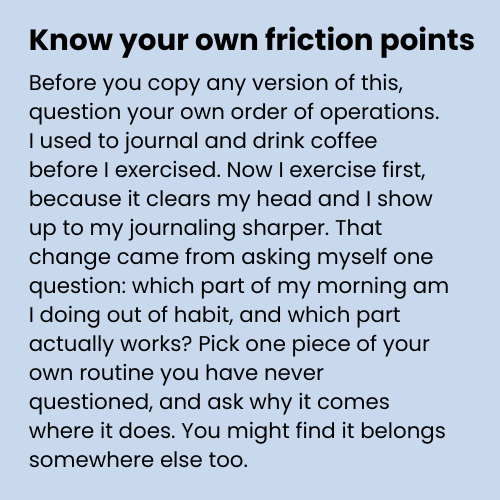
I protect the first hour of my day. No email, no calendar, no reacting to anything. I wake up, do some light stretching, brush my teeth, and drink a full glass of water. Then I exercise, usually a walk or some time on the treadmill.
That is it. It sounds almost too simple to matter, but the point is not the specific steps. The point is that for one hour, nothing outside of me gets a vote in how I feel or what I do that day. I might glance at my phone. I am human. But I am not responding to anything, and I am not letting anything in that hour change my mood before I have even had coffee.
My second hour: ease toward the world
The second hour is where I start letting the day in, on my terms. This is when I journal, review or set my plan for the day, and do some light reading. This is also when I will glance at email, not to respond, but to see what is actually there. Is anything truly urgent? Most mornings, nothing is. But checking during this hour instead of the first one still means I am responding within two hours of waking up. That is fast. Nobody is waiting on me.
This is the part that tends to worry leaders the most. What if my boss emailed something overnight? What if someone needs an answer before the store opens or the first meeting? If something is genuinely urgent, you will still catch it within two hours, and you will read it with a clear head instead of a groggy, half awake one. Most of what feels urgent at 6 a.m. is not actually urgent. It just got there first. I covered some of this in From Overwhelmed to Organized: A Step-by-Step Guide to Managing Email and some of the ideas there may help with this process as well.
By the end of this second hour, I have showered, had coffee, and maybe eaten something. And I already know the one big task I need to get done that day, the thing I protect before anything else pulls me away from it.
A different way to start the morning
The morning routine is not new. Marcus Aurelius was doing a version of it two thousand years ago, and it is interesting to compare how his approach is different from what I am discussing here, or what you’ve read elsewhere.
What I describe above eases the body in first and lets the mind follow. His went straight at the mind. Before he did anything else, he reminded himself what was actually his to control that day and what was not. He also anticipated issues on purpose. He would tell himself, before he even got out of bed, that he would run into people who were difficult, unfair, or frustrating that day. This was his way of preparing himself for any sort of possibility and prevent himself from being caught off guard. (By the way, I think that is a good idea in general, just maybe not right when you wake up.)
If you have ever walked into a situation already knowing a difficult customer, an understaffed shift, or a frustrating corporate directive is waiting for you, you already understand the instinct. The Stoic version simply makes it deliberate instead of dreaded. You name the friction before it shows up, so it lands as something you expected, not something that ruins your day.
Neither approach is more correct than the other. Both are answers to the same question. Who decides how your day starts, you or whatever is waiting on your phone. All of the pieces can add value to ensure you have a productive day. How you choose to use these and stage them for yourself is what matters most.
Try this instead of your usual journal
I usually journal my gratitude, how I am feeling, and what I want to accomplish. That works for me. But if your journaling has started to feel stale, there is a Stoic version worth trying. Three lines, no more. What matters today. What does not matter today. How I will respond when something goes wrong.
That is the entire exercise. It forces you to actually choose, instead of writing until you run out of thoughts. Try it for a week and see if it changes what you pay attention to.
The one big task
However you spend your first two hours, come out of them knowing the one task that actually matters most today. This task should be what must get done, not the one that happens to be at the top of the inbox. The one that, if it does not get done, would make today a wasted day. For me, that is usually decided before I ever open email, when my head is clearest. Protect that task the same way you protected your first hour. Everything else can wait its turn. Really.
You cannot control the morning. You CAN control how you meet it.
You are not going to stop your cortisol from spiking. You may not be able to stop your phone from filling up overnight. But you get to decide how much of your first two hours belongs to you before any of that gets a say. That decision, more than any specific routine, is what actually changes your mornings. Whether you build your morning like mine, like the Stoics, or some version that is entirely your own, the goal is the same. Meet the day instead of getting run over by it. Knowing you have control can become the best part of waking up.
What will you change to ensure you control your morning narrative?
Wüst S, Wolf J, Hellhammer DH, Federenko I, Schommer N, Kirschbaum C. "The cortisol awakening response – normal values and confounds."
Reviews.org. "Cell Phone Usage Stats 2026: Americans Check Their Phones 186 Times a Day." 2026. https://www.reviews.org/mobile/cell-phone-addiction/*
Get leadership tips and new articles you can use directly to your inbox. Join the thousands of other leaders continuing your leadership development journey with Effective Retail Leader.com.
DISCLAIMER: I participate in the Amazon Services LLC Associates Program, an affiliate advertising program designed to provide a means for me to earn fees by linking to Amazon.com and affiliated sites. Other links to third-party products and services may also be affiliate links.