

FAQ - Overwhelmed By Everything That Is Coming At Me. How Do I Keep Up?

This month: How do you find clarity amidst information overload?
One Friday each month, I dedicate the post to looking at some questions I have heard recently from developing leaders. Sharing those questions and my thoughts for them is a way for me to spread the information to as many leaders and future leaders as possible. If you have a question about leadership, or just a situation you would like some additional insight on, please email me at Effective Retail Leader. Let’s take a look at this week’s question.
I am a District Manager and I have many things coming at me at once. I have a hard time keeping everything organized and on track. Everything seems like a priority, plus I continue to get more and more information I need to work through to support my stores. How can I keep my sanity and still be successful?
This is a common challenge and question I hear from Retail Leaders. Time Management is always a subject that people want or think they need to get better at. The feeling of overwhelm is real, and most field leaders are experiencing it. In fact, in many ways new work with AI may be creating even more information and data overload since it is easier to create more analysis and insights than most people have time to respond to. So, let's break this very real question and situation down to help everyone.
The role of a District Manager has always been a juggling act. You are the bridge between corporate strategy and store execution. You are a mentor/coach, an inspector, a firefighter, and a planner all at once. You are also a translator, always working to balance what is being presented to store teams and what the reality is. In the past, the challenge was simply getting enough information to know what was happening. Today, the challenge is the opposite. You likely have too much information. You have dashboards for sales, labor, customer satisfaction, inventory, and compliance.
The adage, “when everything feels like a priority, nothing is,” is true. It becomes nearly impossible to determine what should be next. Furthermore, having many priorities just doesn’t work. That is a dangerous place for a leader to be. It leads to burnout and, frankly, mediocre results because your attention is so divided. We need to move past the old-school idea of just "working harder" or "pushing through it." We need to manage our attention and leverage the new tools available to us.
Filter the Noise
The first step in regaining your sanity is realizing that not every data point requires an action. This can feel challenging, especially when so many things are coming at you from your boss, or the boss’s boss. How do you just not do something? But think about how often ideas or direction change. Or the initial energy dies off shortly after being released and then the new idea fades away. Part of your role is determining what has staying power and impact. It doesn’t mean you won’t everdo the thing, just not right now. The core idea is simple: reduce the noise and concentrate on the most important next step.
As a District Manager, you are bombarded with “activity”, minor fluctuations in data, endless email threads, and non-critical alerts. If you chase every single one, you will never get to the high-impact work. You have to be ruthless about filtering.
Ask yourself: Is this issue a trend or a blip? If it is a blip, set it aside and wait until there is more information to push forward. If there is a pattern or trend, is it actionable right now? If not, schedule it for review later and move on. You must protect your mental capacity for the decisions that actually move the needle.
Prioritize Energy, Not Just Time
I have written before that time and energy are both things we really cannot get more of at any given point. However, we often treat time as the only variable. We try to cram more tasks into the same hours. That usually results in lower quality work, especially when we know we don’t have the energy to complete it.
Instead, match your energy to your tasks. If you are a morning person, do not waste that peak mental clarity on answering routine emails. Use that time for a deeper analysis of your district’s results, longer-range planning, or working on important documentation. Save the low-energy tasks, like approving expenses or scanning daily reports, for when you are naturally less sharp. I know most District Managers review yesterday’s sales first thing in the morning. Just be conscious of how you are using that time and what impact it has. There is a difference between taking a few minutes to be aware of anomalies from yesterday’s results versus digging into details from an ongoing trend. In most cases, you can check sales, then move to something more critical. But perhaps on Mondays, that high-energy morning time is about studying the recent sales trends and planning the visits for the week and follow-up items.
Leveraging AI as a Force Multiplier
This is where we can update our playbook. Traditional time management advice tells you to make a list. That is great, but a list can quickly become a source of anxiety if it is just a long scroll of unorganized tasks.
We now have access to tools like ChatGPT, Google Gemini, and Claude. These are not just for drafting or summarizing emails. They can be genuine productivity partners if you use them effectively.
Here are two ideas on how you can use these tools today to help manage the chaos:
1. The AI-Powered Eisenhower Matrix You are likely familiar with the Eisenhower Matrix, which divides tasks into four quadrants based on Urgency and Importance. It is a useful concept, but sitting down to sort fifty tasks into those boxes takes time we often feel we do not have.
Try this: Take your brain dump of tasks, everything from "Call Store 101 about the broken AC" to "Analyze the Q4 sales forecast”, and paste it into a secure AI chat window. Ensure you are not sharing confidential employee or sales data, but the tasks themselves are usually safe to process.
Give the model a prompt like this: "I am a district manager in retail. Here is my list of tasks. Please organize these into an Eisenhower Matrix for me. Provide a brief rationale for why you placed each item where you did."
In seconds, you have a prioritized roadmap. You can then look at the "Urgent and Important" box and know exactly where to start. It removes the decision fatigue of "What do I do next?" and lets you get straight to work. It may not be perfect, but it can become a starting point for sorting out your different activities.
Below is an example of what using those steps might look like in Claude. I used the prompt above, gave it a sample list of tasks, and it produced a full text version of the Eisenhower Matrix. Then I asked for a charted version. It took about three minutes total.
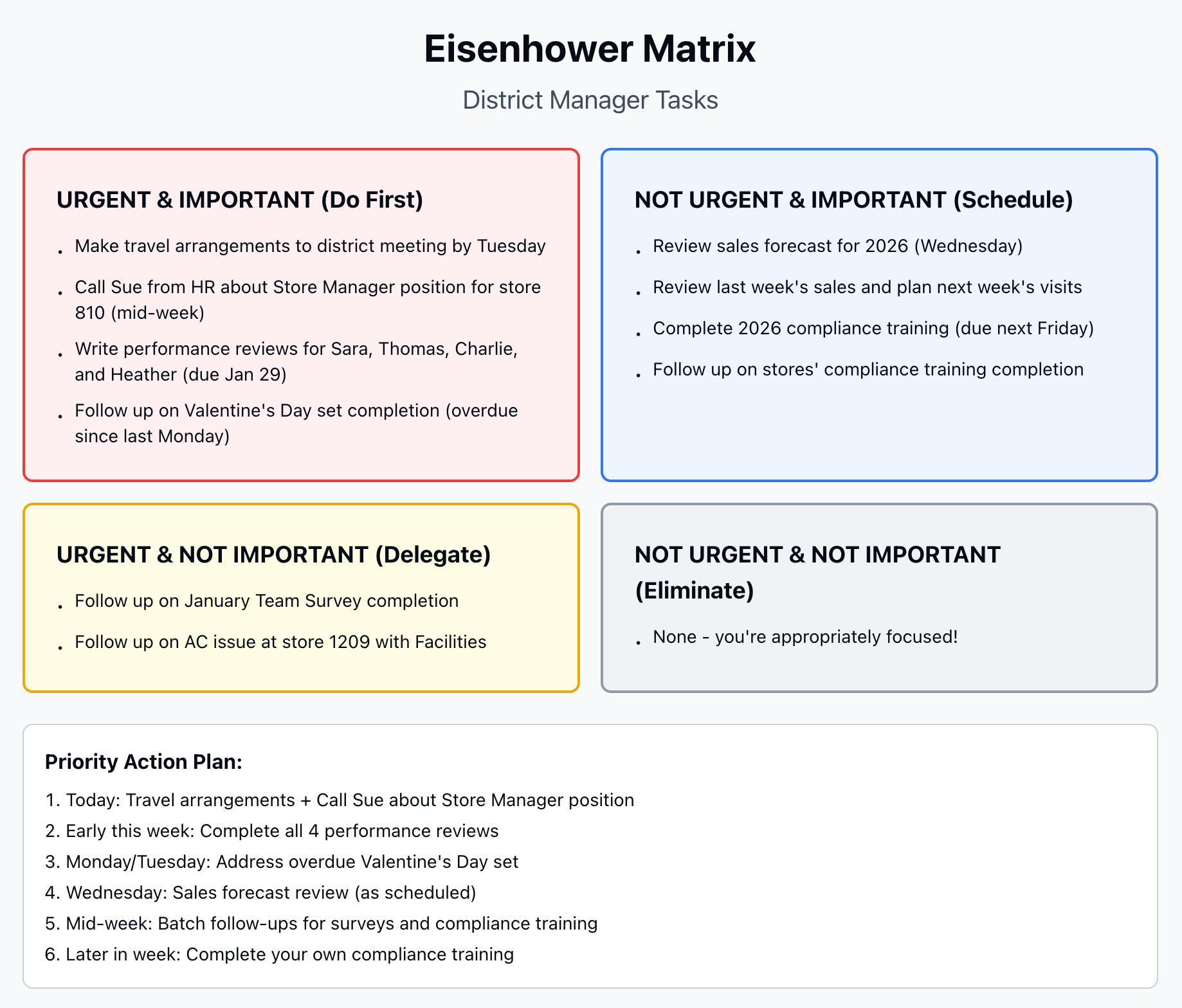
Charted version of the Eisenhower Matrix produced by AI
This is likely a place where trying it and refining it will make it better and specific to you over time. It is certainly worth trying to see what different perspectives may come from something that is not emotionally attached to the task or who may have assigned it.
2. The Decision Partner One of the hardest parts of the job is deciding where to physically be. You have ten stores, and you can’t be in all of them. How do you decide?
You can create a simple "agent" or just a recurring chat thread to help you decide. Imagine pasting your high-level observations for the week into the tool: "Store A is down in sales but has a new manager. Store B is up in sales but engagement scores just dropped. Store C has a big visit next week."
Ask the model, "Based on these factors, rank my store visits for next week in order of impact. Which store needs my support the most versus which store just needs a check-in?"
The AI helps you weigh the variables objectively. It might remind you that a new manager at Store A is a critical investment that outweighs the dip in engagement at Store B for this specific week. It acts as a sounding board to clarify your own thinking.
The Human Element Remains
Using these tools does not replace your judgment. In fact, in many ways it may enhance it and give you more options to review. I am still a firm believer that nothing is going to replace the human interaction for leadership. What this can be is a way to clear away the administrative clutter so you can get back to the part of the job that actually matters: the people.
As noted above, you cannot automate a coaching conversation. You cannot use an algorithm to build trust with a struggling Store Manager. But if using these tools saves you five hours of planning and admin time a week, that is five more hours you can spend on the sales floor with your teams.
Start Small
Do not try to overhaul your entire workflow overnight. Pick one thing. Maybe this week you commit to "batching" your administrative work so you are not multitasking all day. Maybe you try using Gemini to help prioritize your schedule for next week.
The goal is not to be a perfect robot of efficiency (that seems to defeat the purpose and point of this whole thing). The goal is to feel in control of your day so you can support your teams effectively. When you lead with intention and use the resources available to you, you stop drowning in the noise and start making a difference. You have the skills to do the job. Now, give yourself the structure and the tools to enjoy doing it.
How are you using AI or other tools to prevent yourself from drowning in too much detail?
Get leadership tips and new articles you can use directly to your inbox. Join the thousands of other leaders continuing your leadership development journey with **Effective Retail Leader.com. **
DISCLAIMER: I participate in the Amazon Services LLC Associates Program, an affiliate advertising program designed to provide a means for me to earn fees by linking to Amazon.com and affiliated sites. Other links to third-party products and services may also be affiliate links.