

The Costco Blueprint: Why Knowing Who You Are is the Ultimate Retail Strategy
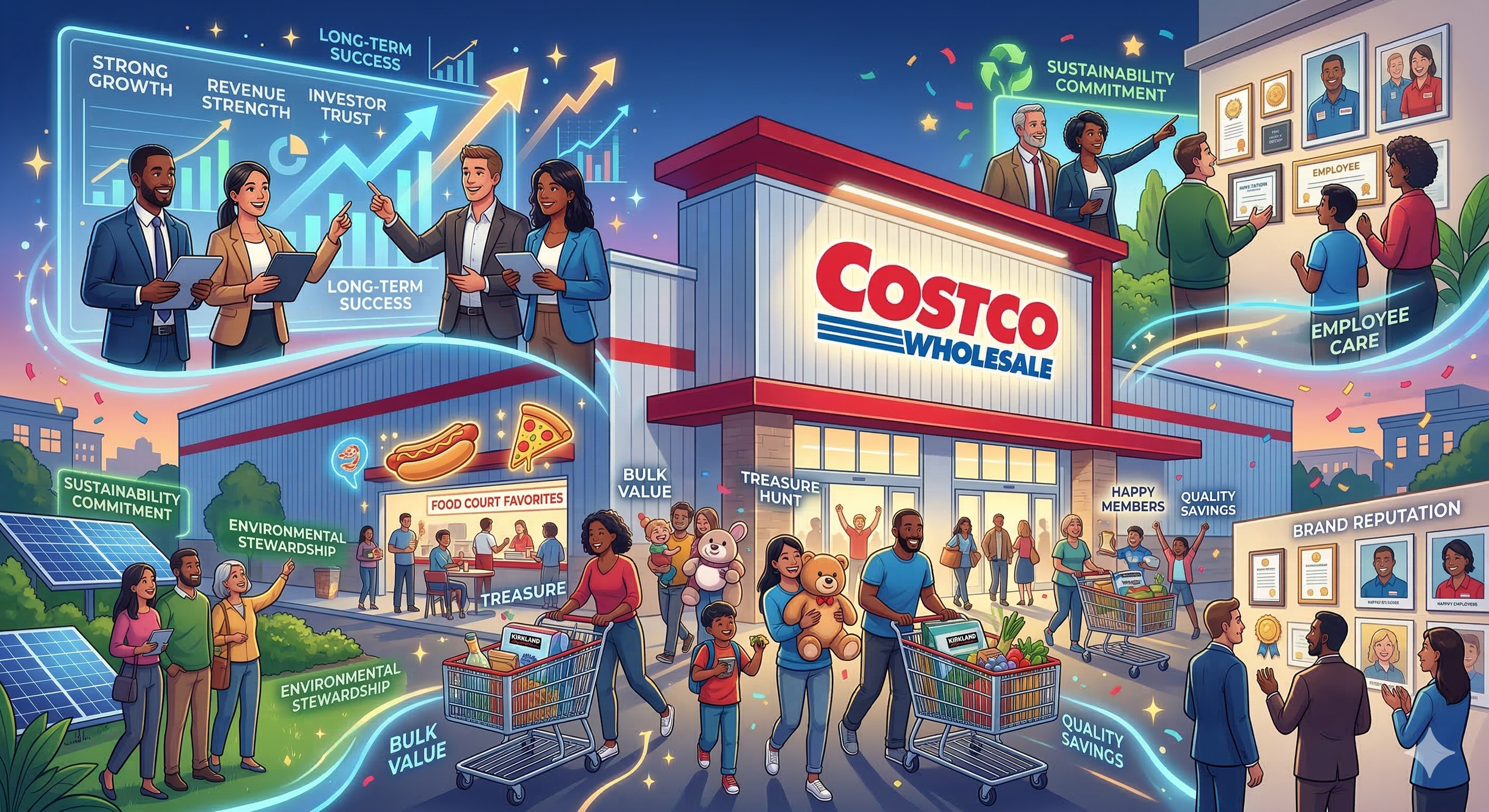
Why internal clarity leads to external retail success.
In the year 2000, Costco generated roughly $32 billion in revenue. When the company recently reported their full-year 2025 earnings, total revenue had skyrocketed to over $275 billion. That is a big leap forward. Consistent performance over the last two and a half decades. While the industry weathered the massive rise of e-commerce, a global pandemic, and multiple economic recessions, Costco multiplied their business nearly eight times over and climbed to the very top tier of the Fortune 500 (Ranked #12 as of the most recently published account).
Retail is complicated and full of distractions right now. Between shifting consumer demands, volatile supply chains, and sweeping economic changes, it is easy to see why so many companies lose their way. Yet in this chaotic environment, Costco stands out with metrics that most executives can only dream of. Over 55 percent of Costco's U.S. employees have five years or more of service. Their turnover rate sits around 8 to 10 percent. This is a sharp contrast to the 60 percent average turnover seen across the rest of the retail industry. It is not uncommon to see many retailers with over 100% turnover for their front line, non-manager hourly employees.
How Costco is Different
“Focus on the customer.” How many times have we heard that, but not necessarily seen it backed up by the actions and support. Many of us have sat in strategy meetings where the conversation drifts away from what the core customer actually needs. When the overall market begins changing or challenges arise, the natural instinct is to try and do everything at once to keep up. Or to start cutting costs and expenses to protect the P&L. It is incredibly difficult to stay the course when everyone around you is in a panic for what to do next. It can feel more like a guessing game than a real strategy for anything specific.
But then you look at Costco. While other retailers try to chase trends, Costco succeeds because they know exactly who they are. They do not try to be everything to everyone. They stick to a very specific set of foundational principles, and as a result, they continue to dominate the retail industry. They know their customer. They have their principles. They stick to their plan.
Here is a look at what makes their model so successful and how you can apply these concepts to your own business.
The Foundation of Discipline and Low Churn
Costco takes a very unique approach to product management and margins. Most conventional retailers rely on product markups of 25 to 50 percent to make a profit. Costco intentionally caps its markups at roughly 14 percent for brand-name items and 15 percent for its private label. The real profit engine of the company is the membership fee. This structure creates a completely different level of commitment from the customer, but it also creates a massive obligation for the retailer. They have to deliver rock-bottom prices and unmistakable value every single day to justify that renewal fee. Costco customers appreciate the product assortment, the treasure hunt, and especially the consistency of value oriented pricing.
This unwavering commitment to the price-to-value ratio results in a staggering global membership renewal rate of roughly 93 percent. In their 2025 fiscal year alone, Costco brought in $5.3 billion in membership fees from a base of over 145 million cardholders. That exceptionally low customer churn is a huge competitive advantage. When a business keeps the vast majority of its customers year after year, it does not have to spend tons of time and money just to replace the people who walked out the back door. Instead, Costco is always focused on adding to its base, which fuels sustainable, long-term revenue growth. That is a significant difference compared to many other retailers who constantly see customer churn and the need to backfill with new customers to the brand.
Maximizing the Warehouse and the Treasure Hunt
They also win through simplicity. A typical mass retailer may carry more than 10,000 skus, and grocers well over 100,000 skus. Costco carries roughly 3,600 to 4,000 active SKUs. This limited selection accelerates inventory turnover, simplifies logistics, and gives them unmatched purchasing power.
Costco warehouses are designed for high efficiency and high volume. Products are often displayed on the exact same pallets they arrived on. This layout eliminates the high labor costs associated with breaking down boxes and hand-stocking individual items on a shelf. Furthermore, it creates a highly flexible environment for their famous "treasure hunt" shopping experience. They frequently rotate non-staple items in and out of the building. It creates a sense of urgency for the customer. If you see something unique, you buy it, because it might be gone tomorrow.
The Power of Kirkland Signature
If you want to understand how Costco maintains its edge, look no further than Kirkland Signature. It is not just a budget-friendly store brand. As highlighted in their recent 2025 earnings report, it is a premium powerhouse that just crossed $90 billion in annual revenue globally. Their private brand alone would rank in the top 50 of the Fortune 500.
Creating a single, unified private label was a huge risk years ago when the industry standard was to create dozens of different brands for different product categories. But the risk paid off. Kirkland Signature is designed to match or beat the quality of national brands at a fraction of the price. Costco continues to aggressively expand the label into new categories, introducing items like grass-fed meat sticks and ready-to-drink cocktails just this past year.
This strategy gives Costco a lot of leverage at the negotiation table. If a national brand will not offer the right price, Costco can simply lean into its own label. It protects their margins, builds intense customer loyalty, and elevates the perception of their entire inventory. People see Kirkland as a premium label, not as a second tier offering or compromise.
People as an Investment, Not a Cost
In retail, payroll is usually the first target when executives want to cut expenses. Costco views its people entirely differently. They operate on a "good jobs" strategy. The company pays its workers an average hourly wage of more than $32 in the U.S. and provides exceptional health and retirement benefits. Over 94 percent of their U.S. employees are eligible for health benefits.
This is all part of an overall business strategy that came from its founder(s). Jim Sinegal (founder of Costco) built the company culture around a very clear philosophy. Sol Price, credited as a the father of the warehouse club concept, also believed firmly in putting the employee first in order to create a better customer experience overall. Sinegal worked directly for Price and then oversaw the combined companies when Costco and Price Club merged. Sinegal insisted on paying employees above-market wages, treating vendors fairly, and obsessing over member value. Because of their incredibly low turnover and high tenure rates, Costco spends significantly less time and money training new hires. Experienced employees work faster, provide better customer service, and help maintain the strict operational discipline required to keep costs low.
A majority of their warehouse managers (and executives) started as hourly employees on the floor. That level of institutional knowledge is a massive competitive advantage. To prove that point, current CEO Ron Vachris did not get hired into executive suite from outside the Company. He started his career in the early 1980s working as a forklift driver for Price Club. Over the course of four decades, he worked his way up through warehouse management, real estate development, and merchandising before taking the helm as CEO in early 2024.
Navigating the Macro Environment
One of the truest tests of a retailer's identity is how they handle economic headwinds. During their 2025 earnings report recently, leadership made it clear that their absolute priority remains managing the price-to-value ratio for the member. When facing supply chain shifts and inflation, Costco uses its agility to pivot quickly. If a product becomes too expensive, they use their limited SKU model and bulk buying power to force suppliers to compete for shelf space, keeping prices in check. They willingly absorb costs rather than pass the pain down to the consumer, knowing the resulting loyalty pays off exponentially.
To ensure long-term supply chain stability, they have even shifted toward producing some of their own high-volume items. By creating a vertically integrated chicken complex for their rotisserie chickens and localizing the production of heavy items like bottled water, they control costs and avoid freight issues. They understand that their primary job is to protect the member at all costs. I love that they look for ‘out of the box’ solutions rather than taking the easy route of simply raising prices.
Upgrading the Experience on Their Own Terms
A few years ago, critics called Costco a laggard in the digital space. But Costco did not panic. They quietly upgraded their technology in a way that complemented their core business instead of distracting from it.
They expanded their e-commerce offerings to include big-ticket items like furniture, appliances, and jewelry. To manage the inventory and delivery of these "big and bulky" goods, they created Direct Distribution Centers. They also partnered with third-party logistics providers like Instacart for same-day grocery delivery to meet convenience needs without building out an expensive, proprietary network. Inside the warehouse, they introduced digital membership wallets and pre-scanning technology at the registers to speed up checkout times. They modernized the customer experience while fiercely protecting the in-store traffic that drives their financial success. They are rarely the first to market with technology advancements, but when they do apply them, they are usually well thought out, customer-first driven solutions. They do not just copy what is happening at Walmart, Sam’s Club, or others. They know who they are and what they need to offer to their customers. They are a lot like Apple in that regard. Not first, just better.
Applying the Blueprint
There is a lot to learn from the Costco model. You do not have to operate a multi-billion dollar warehouse club to apply these principles to your own store or district. The primary lesson is about clarity and intention. There are no shortcuts or silver bullets in retail. Success comes from knowing your core identity and refusing to compromise on it. Invest heavily in your people so they can take care of your business. Obsess over the value you provide to your customers every single day.
When you strip away the distractions and concentrate your efforts on what truly matters, you build a team and a business that can withstand economic shifts, changing trends, and fierce competition. Stick to your foundations. Make the tough choices that protect your customer. The results will follow. Costco is proof.
What lessons from Costco can you apply to your specific business?
Get leadership tips and new articles you can use directly to your inbox. Join the thousands of other leaders continuing your leadership development journey with **Effective Retail Leader.com.**
DISCLAIMER: I participate in the Amazon Services LLC Associates Program, an affiliate advertising program designed to provide a means for me to earn fees by linking to Amazon.com and affiliated sites. Other links to third-party products and services may also be affiliate links.